AVOWAL

The complete AI command center for the practice of law.

Thirty-four modules run by one agent layer — ELARIA — the complete back-end of a law practice: acquisition, deadlines, discovery, evidence, drafting, filing proof. Its trust is built into the schema, not promised in a policy — the machine never files, never sends, never serves, never charges; every external act ends at a human hand on a door.

Patent-pending — 88 claims / 8 subsystems Launching in Connecticut first Cloud / hybrid / in-house / air-gapped
The AVOWAL explainer film Runtime 49:04 — 1080p
The problem

Generic legal AI is a text box.
A practice needs a back-end.

The legal-AI wave produced wrappers, not infrastructure — and its failure mode is now a matter of public court record across the country: fabricated citations, invented authority, filings sanctioned because a model asserted what no source supports. The category's unsolved problem is not capability. It is trust.

Meanwhile the actual back-end of a law practice — transcript acquisition, deadline computation, discovery arithmetic, service of process, exhibit custody, filing proof — remains manual and fragmented. Practice-management suites, legal-AI tools, judge analytics, discovery platforms — each owns a slice, none owns the whole, and none of it composes. Nobody offers the composite: the complete command center that works the same whether you are a solo practitioner running a limited-scope matter or a hundred-lawyer firm. And nobody can honestly claim the trust architecture, because theirs is a policy and AVOWAL's is a schema.

The platform

Thirty-four modules. One runtime. One door.

Every module runs as a family of triggered loop turns: an isolated generator, an independent evaluator that verifies by acting, a scope auditor, an append-only record — and a human door before anything leaves the building.

Below: ten of the thirty-four. Each interface shown is a design preview from the product mockup library — the intended product, honestly presented as a preview.
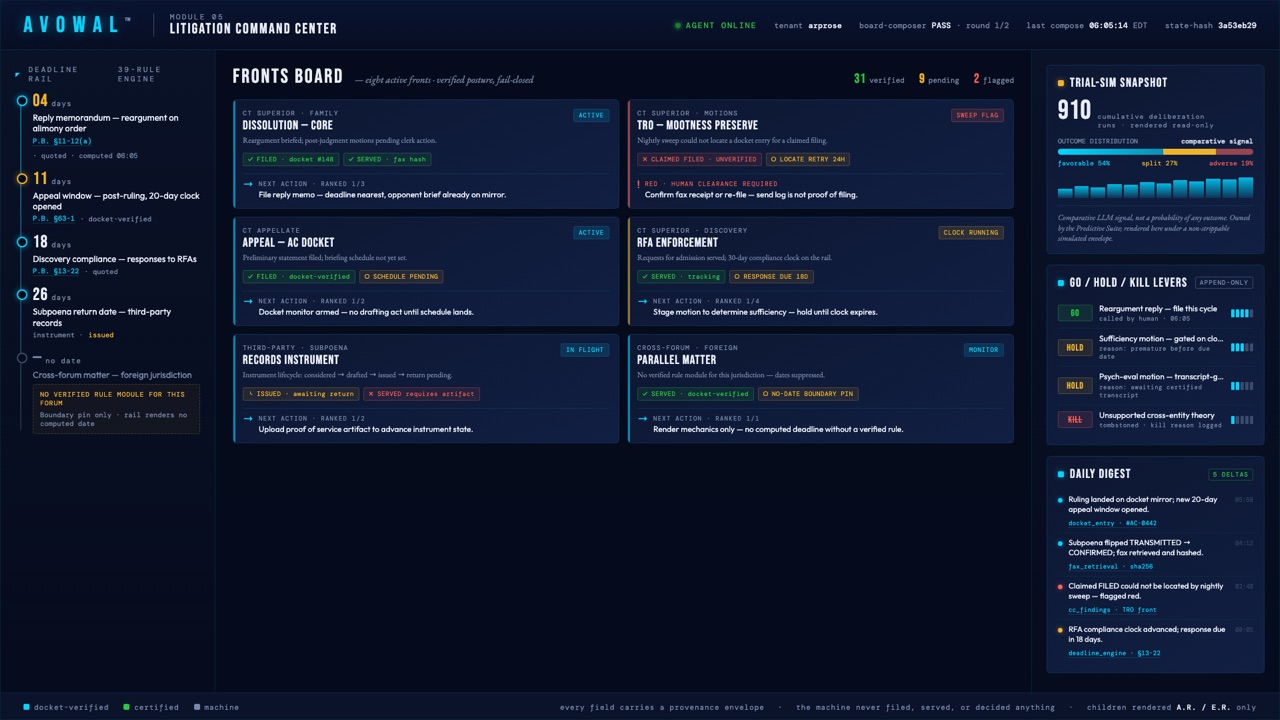
Litigation Command Center interface
Command
Litigation Command Center

Every matter, deadline, filing, and open loop on one operational surface — the practice's single pane of truth.
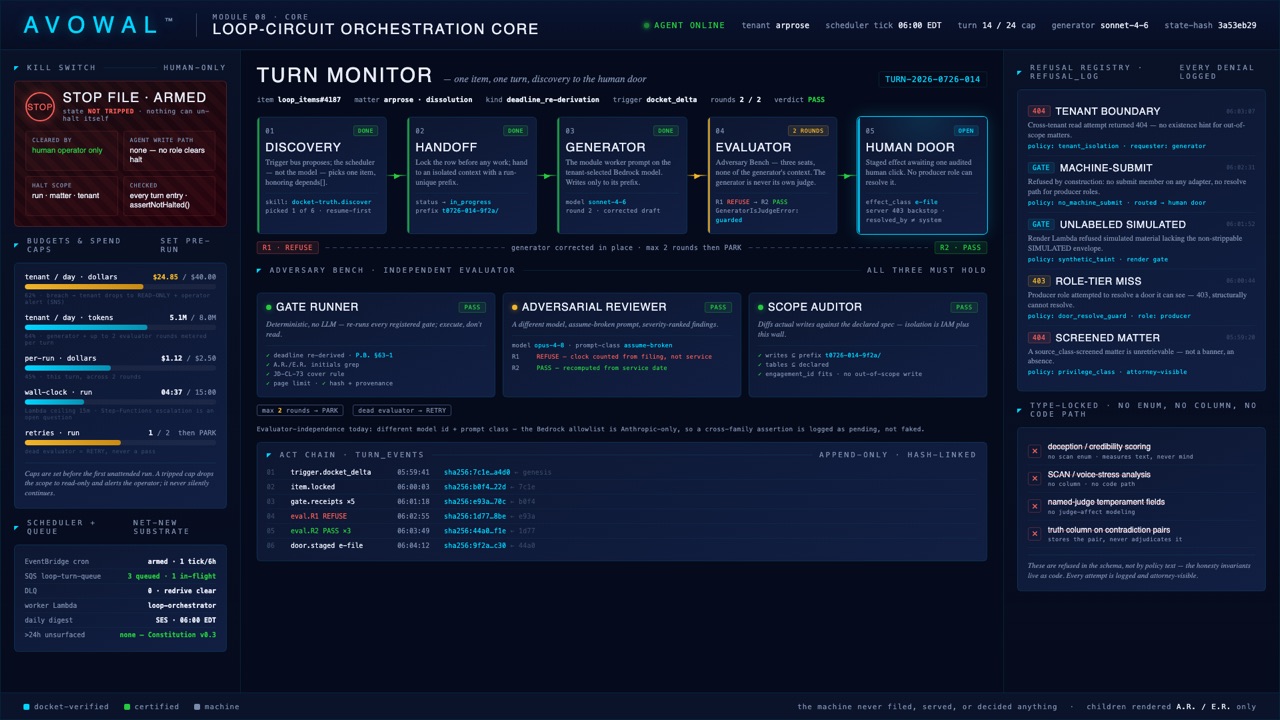
Loop-Circuit Orchestration Core
Runtime
Loop-Circuit Orchestration Core

The engine room: isolated generators, independent evaluators, append-only records, and the human door — as architecture, not policy.
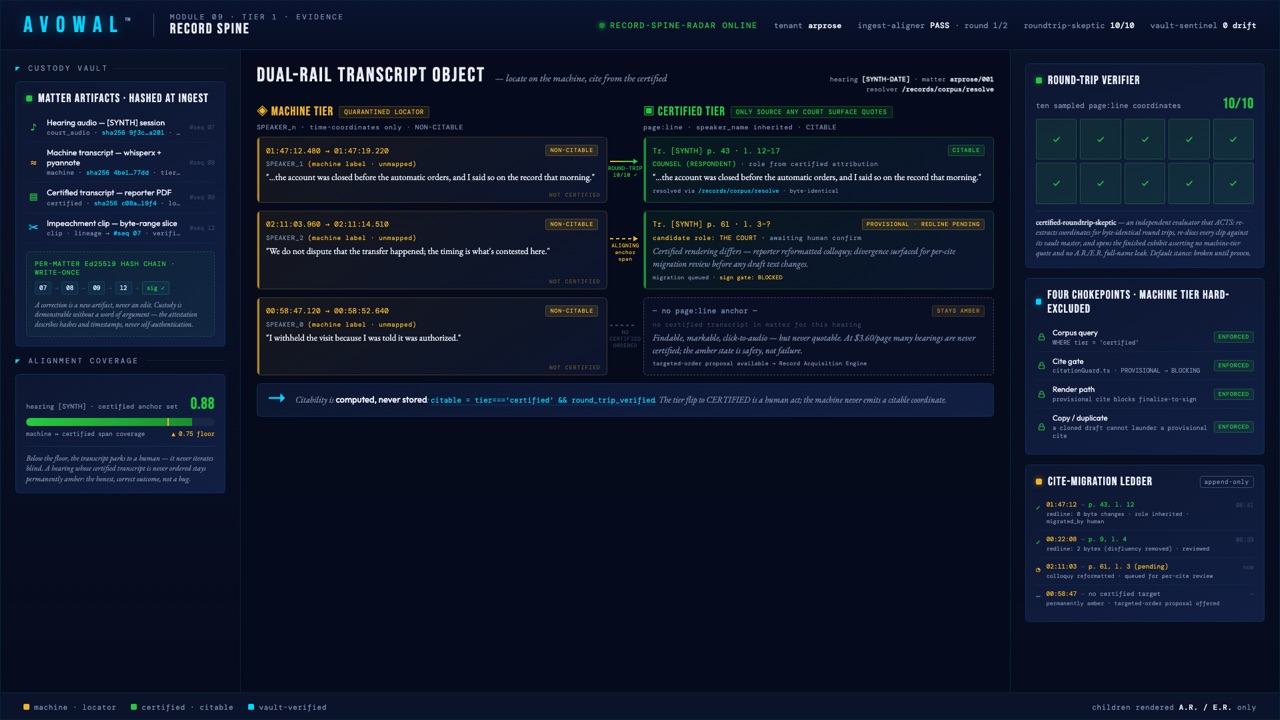
Record Spine
Records
Record Spine

Locate on the machine transcript; cite only the certified one — enforced as database constraints, not guidance.
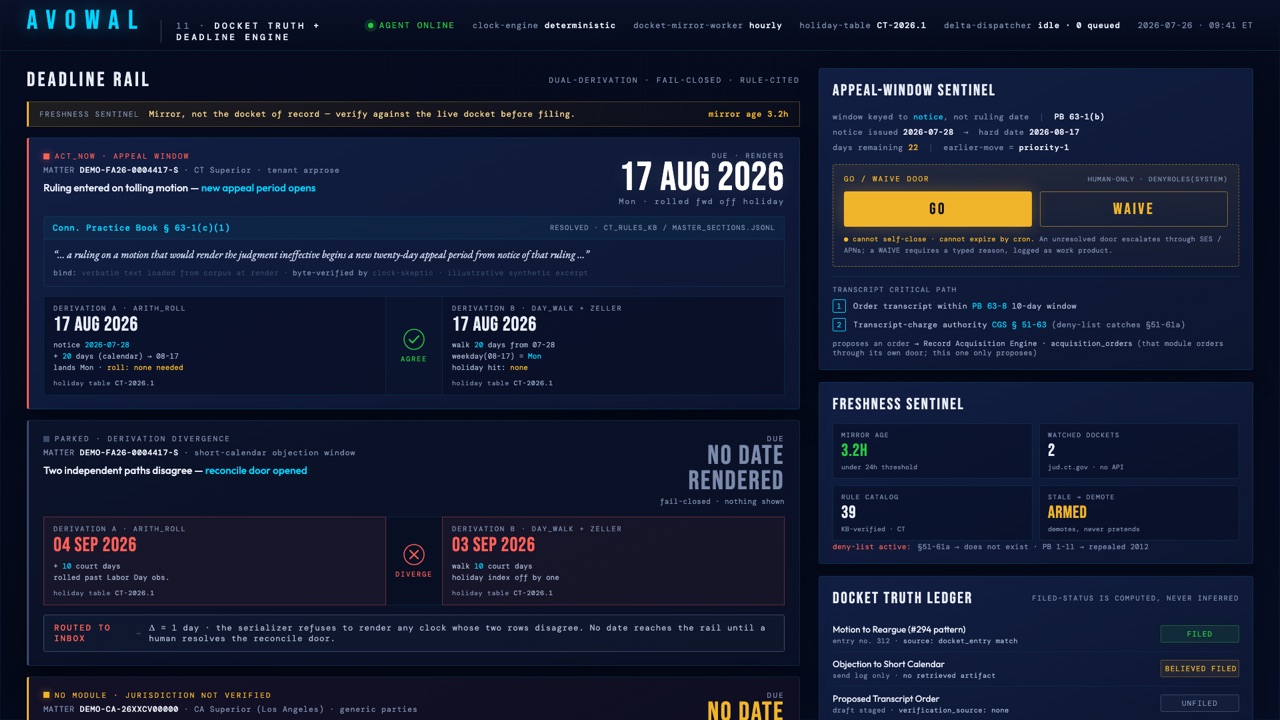
Docket Truth and Deadline Engine
Deadlines
Docket Truth + Deadline Engine

Rule-verified deadline computation on a docket the system re-verifies against the court's own record — never a cached guess.
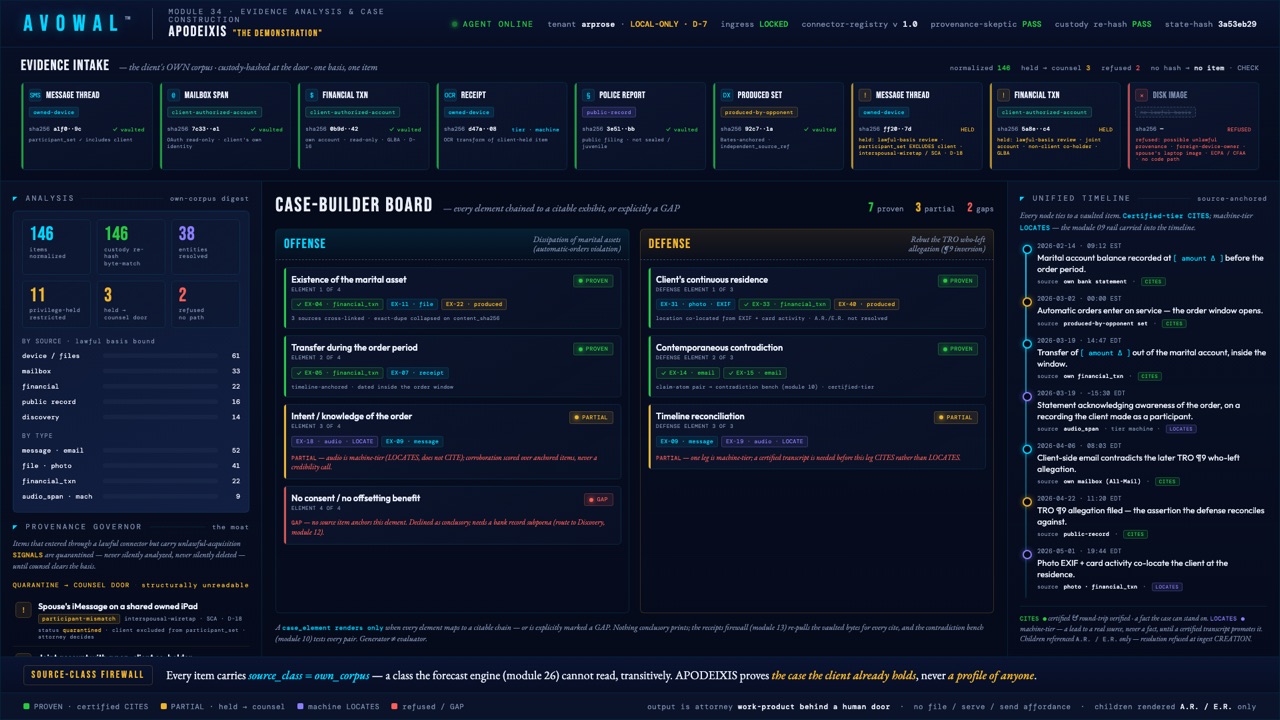
APODEIXIS evidence engine
Evidence
APODEIXIS — Evidence Engine

The client's own lawfully-held corpus, custody-hashed and built into a source-anchored, element-by-element case. Unlawful provenance quarantines by construction.
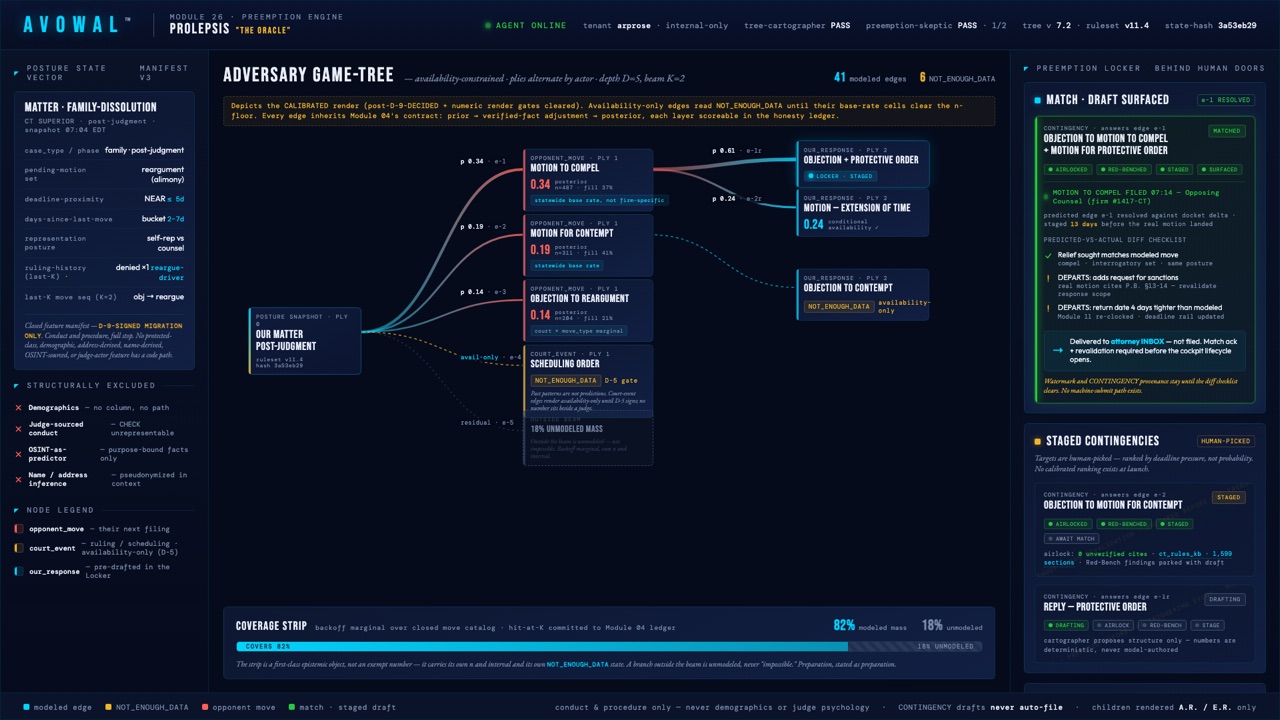
PROLEPSIS preemption engine
Prediction
PROLEPSIS — Preemption Engine

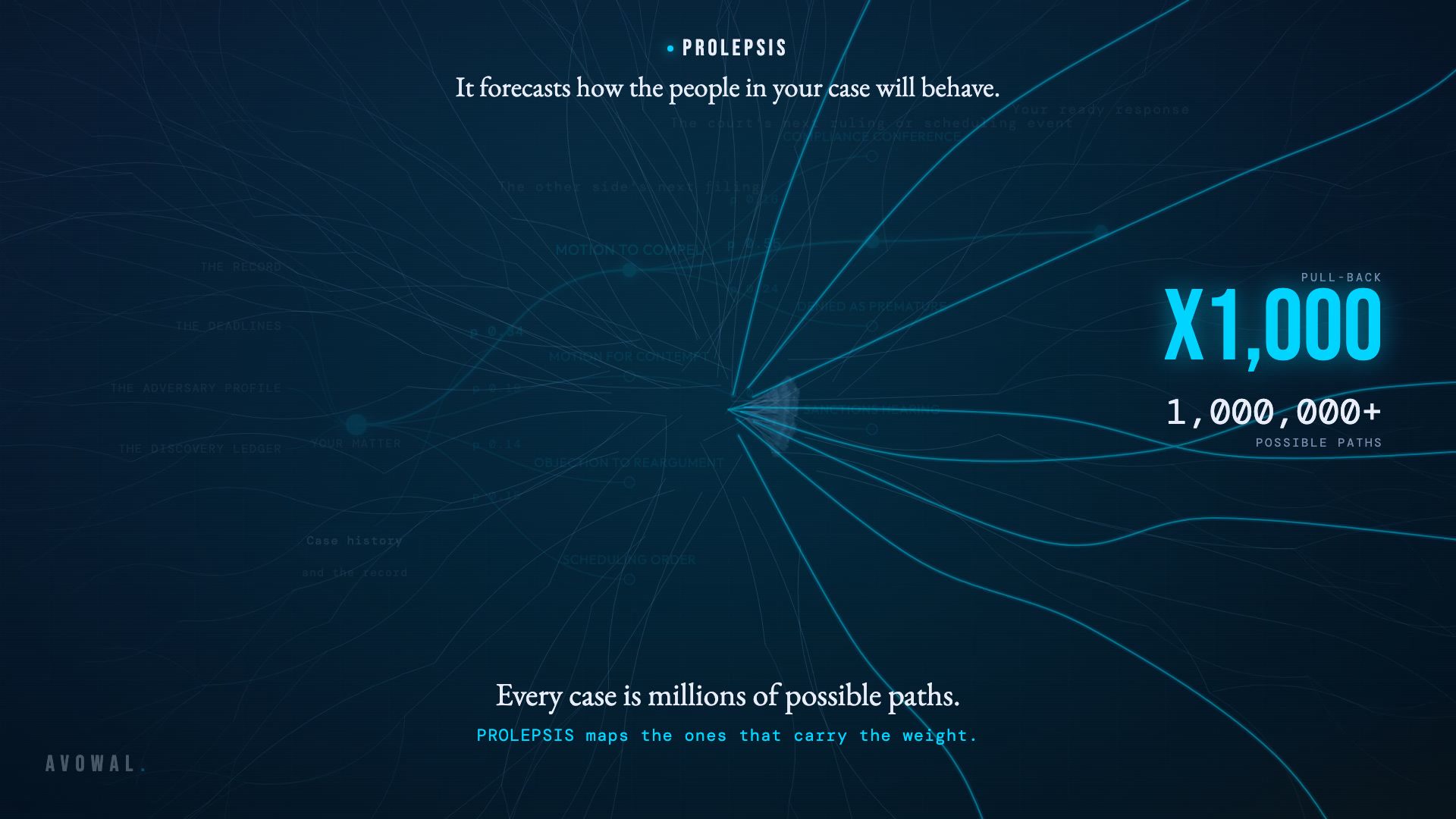
Plays the adversary's game tree forward and pre-drafts verified responses to the likeliest moves — before they are filed.
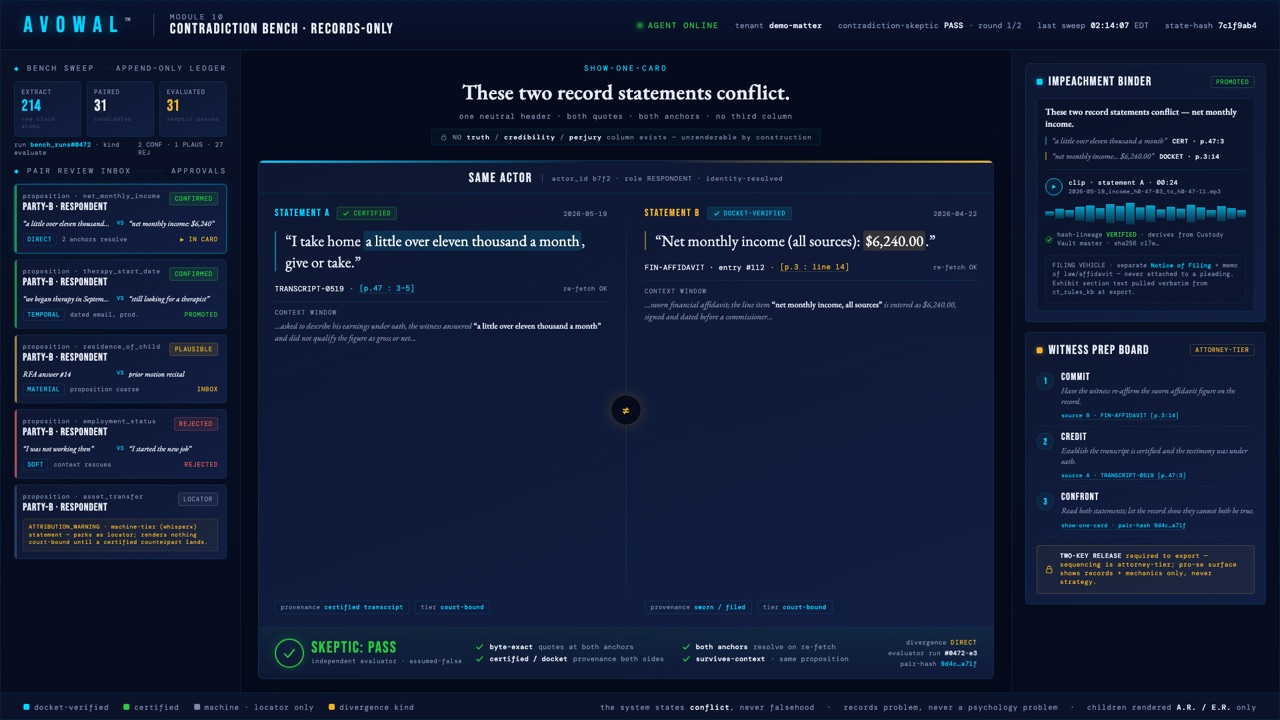
Contradiction Bench
Analysis
Contradiction Bench

Every inconsistent position an opposing party has taken, indexed against the certified record and staged for use.
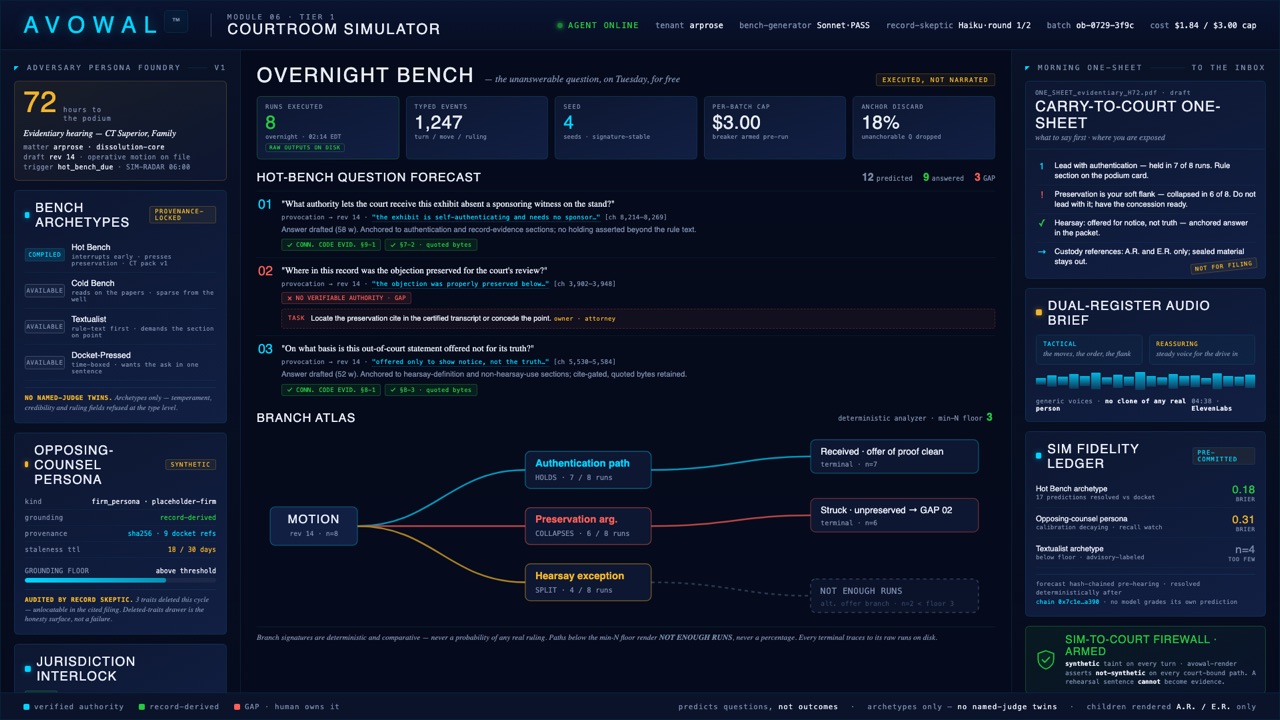
Courtroom Simulator
Preparation
Courtroom Simulator

Argue the motion before the hearing — against an adversary and a bench built from the record of the matter itself.
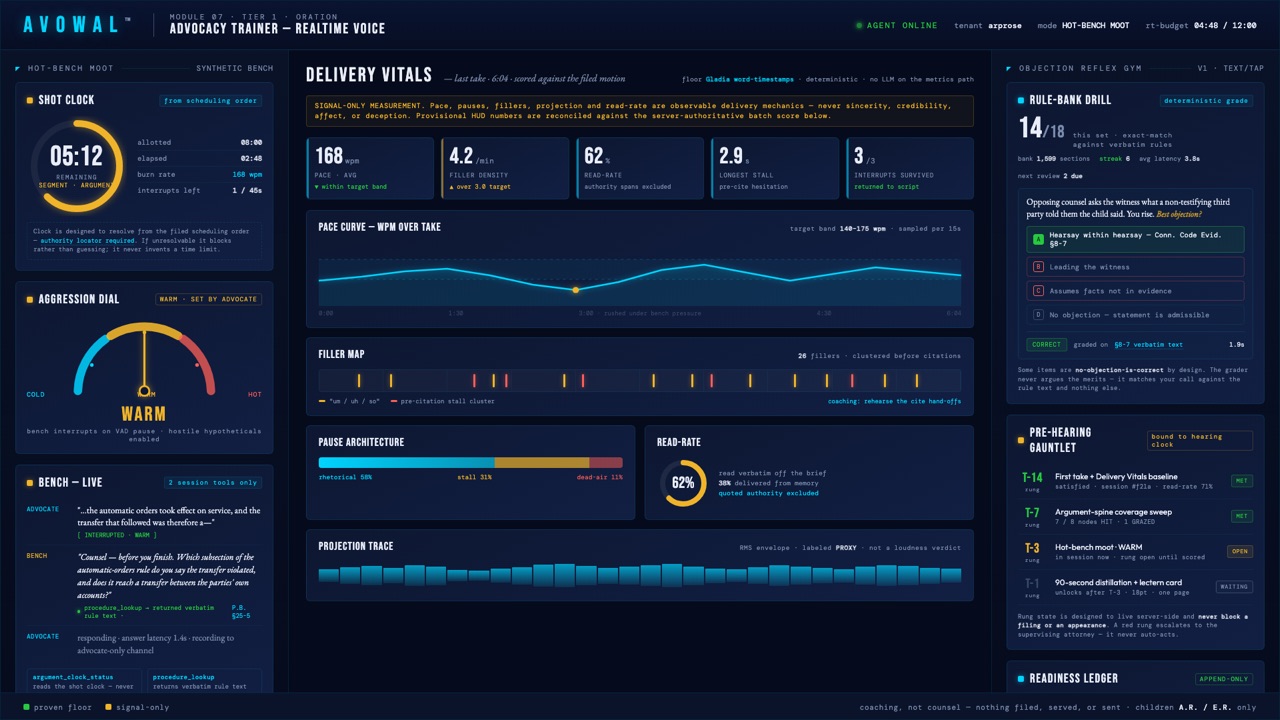
Advocacy Trainer
Training
Advocacy Trainer

Realtime voice advocacy practice with structured feedback — repetition an attorney can afford.
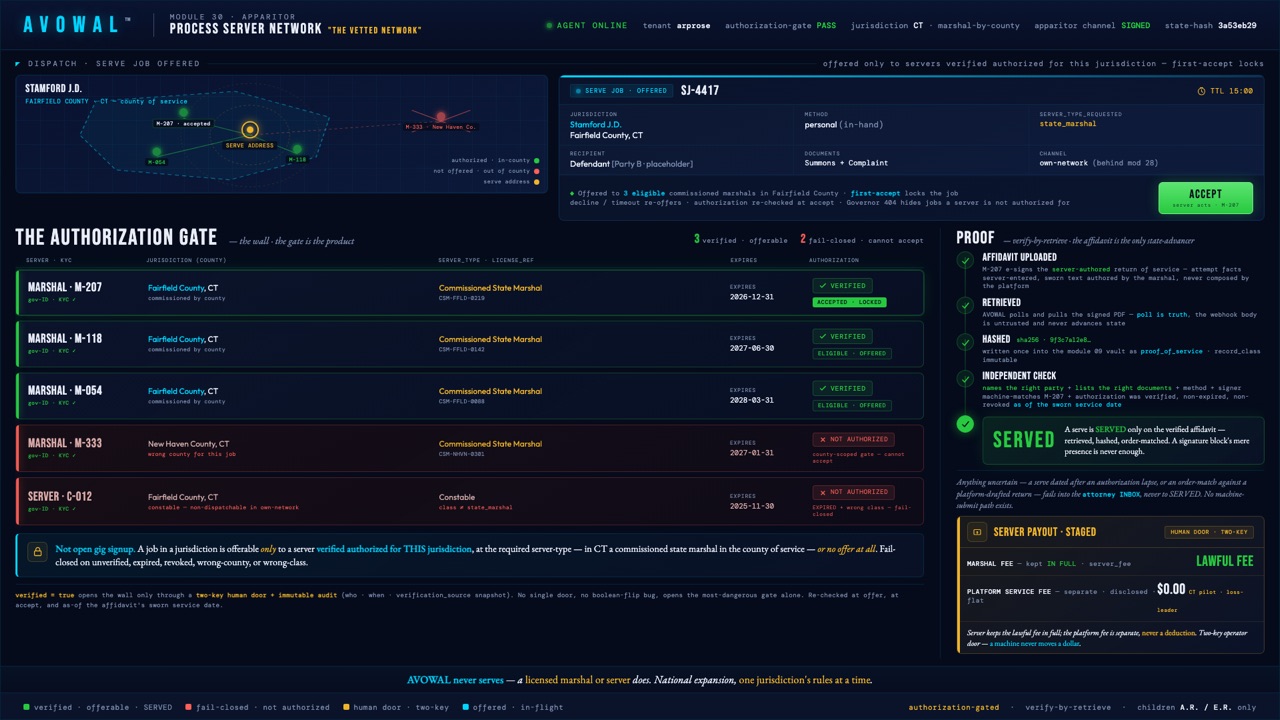
APPARITOR service of process
Service
APPARITOR — Service of Process

The officer serves; the platform proves it. SERVED means the signed affidavit came back — never a dispatch log. Productized standalone below.
ELARIA and the honesty moat

What the machine never does is the product's first-class surface.

A wrapper can add a disclaimer. It cannot retrofit an append-only hash-chained spine, provenance computed at render, schema-level cite gates, and deleted machine-submit paths. These are not policies. They are the schema — and that is why they cannot be forged.

Never files, sends, serves, or charges

Every external act terminates at a human door — by construction: deleted code paths, not policy documents.

Verify-by-retrieve

FILED means a retrieved, hashed, clerk-endorsed conformed copy. SERVED means the signed affidavit was retrieved and hashed. Nothing advances on a send log.

Locate-on-machine, cite-on-certified

Machine transcripts locate; only certified transcripts cite — enforced at the query, cite-gate, render, and copy/paste layers.

No fabricated citations

A fail-closed citation airlock backed by verified packets. Unresolvable authority is struck, not softened. Known fabricated-cite incidents are a permanent deny-list.

Fail-closed authorization

Unverified jurisdictions render no method and no date. Undecided counsel gates block code rather than defaulting. Refusal categories are type-locked — no enum, no code path.

Calibration-licensed numbers

Every user-facing forecast is licensed by a calibration ledger with non-overridable demotion. A model may never resolve its own prediction. NOT_ENOUGH_DATA is a first-class rendered value.

“Their responsible-AI is a policy. Ours is a schema.” The moat, in one sentence

As courts sanction fabricated-cite filings and bar regulators move on AI-assisted practice, “the machine cannot file and cannot fake a cite” converts from a constraint into the buying reason — for malpractice carriers, for ethics-sensitive firms, and for regulated markets. And the architecture was validated twice: two fully independent planning runs over the same asset base converged on the same flagships, the same runtime, and the same non-negotiables, down to mechanism level.

~25,000
Lines / 106 API paths, live stack
39
Verified CT deadline rules
1,565
Firm litigation profiles
8,283
Document KB architecture
1,599
CT rules-bank sections
~90%
Pure extension of deployed code

Engineering inventory per the internal plan — internal counts, not audited.

Provenance and proof

Forged in a courtroom, not a lab.

AVOWAL began in the founder's own Connecticut litigation in February 2026. Every subsystem exists because a live case demanded it — and the failure lessons (a fax confirmation is not a filing; a send log is not service; a machine cite is not authority) are encoded as gates. Ten specialized agents grew into ELARIA. Local custom models ran on the founder's own hardware. One engine now powers three market surfaces — evidence the architecture generalizes.

Frame from the AVOWAL explainer film — PROLEPSIS, the preemption engine
From the explainer film — PROLEPSIS, the preemption engine
This raise — the attorney platform

AVOWAL

Launching in Connecticut first: a single-tenant proving ground on the founder's live matters (Decision D-1, decided 2026-07-29), design-partner attorney tenants thereafter. Per-matter, flat-fee pricing for limited-scope practice — the competitive void incumbents price past. Pre-revenue; no traction claimed.

The free public resource

Find Your Footing

findyourfooting.org — free forever for self-represented litigants. The access-to-justice surface, and the working proof that the engine's mechanics-not-advice rails hold for unsupervised users.

The regulated-market proof point

VIGIL

A patent-pending REMS / cryptographic-dispensing suite: the same verify-by-retrieve, fail-closed, human-door architecture applied to an FDA-regulated context. Its role here is proof the honesty architecture sells in regulated markets — not a funding ask of its own.

The standalone spin-out

APPARITOR — the officer serves. We prove it.

Module 30, productized standalone (apparitor.ai): an authorization-native, two-sided marketplace for service of process in officer-served jurisdictions. The officer is paid in full, free forever on the platform; the fee is recognized only on airlock-verified proof — the signed affidavit, retrieved and hashed.

APPARITOR
National serve events / year20–40M Estimate
Funded comparable (Proof Technology, reported)~$62.6M total raised
Largest single network (ABC Legal)2,000+ servers / 1M+ docs yr
Connecticut wedge~180 marshals / $50 statutory fee (CGS 52-261)
Complete deliverable tree on diskSpec, deck, apps, API, ops, site

Market figures sourced in the APPARITOR research file (URL-cited); estimate-tagged bands stay tagged. Honest posture: the CT pilot proves gates and proof capture, not marketplace liquidity — defensibility is the authorization registry, the proof airlock, and officer-side trust, not speed to national coverage.

Visit apparitor.ai →

Patent-pending and air-gapped

Protected filing. Local-first engine.

Patent-pending

88 claims, 8 subsystems

AVOWAL provisional patent filed April 2026 — 88 claims across 8 subsystems. A provisional application, not a granted patent. Related families: VIGIL's patent-pending REMS/cryptographic-dispensing suite and the A2BE provisional portfolio.

Designed local-first

Runs fully air-gapped

The engine was born on local custom models on the founder's own hardware — so cloud, hybrid, in-house, and fully offline / air-gapped postures are native, not ports. A firm that cannot send privileged material to a cloud API can run the entire platform behind its own walls.

Roadmap

Connecticut first. Counsel-gated. Dependency-ordered.

Four phases, effort-sized and dependency-ordered — deliberately not dated. New markets open only when their legal posture is signed.

Phase 1

One truth, one door

Loop-Circuit Core, Litigation Command Center, Docket Truth + Deadline Engine — single tenant. Exit: one finding travels end-to-end through generator, adversarial evaluator, human door, act chain; zero machine-submit paths exist in the codebase.

Phase 2

The record and the factory

Record Acquisition (CT-first), Record Spine, Discovery Enforcement, Receipts Firewall, Exhibit Bench.

Phase 3

The moat, measured

Actor Dossiers, Temperature Engine, Predictive Suite, unified Contradiction Bench, PROLEPSIS MVP; design-partner onboarding prep at exit.

Phase 4

The door opens outward

Courtroom Simulator, Advocacy Trainer, service / notarization / mail / fax / e-filing channels, first outside tenants, tenant-facing hardening.

The counsel-gate system: D-1 through D-18

Eighteen decisions that block code — each with an owner, a due date, and a stated consequence. A decision past due blocks the code it gates; it does not default. Provider postures, terms-of-service review, consent regimes, worker classification, IOLTA separation — every regulated edge is fail-closed until counsel signs. This is what “we will not build the compliance event” looks like as an operating system: the same architecture that makes the product trustworthy makes the company underwritable.

D-1 (TENANT #1): DECIDED 2026-07-29 — single-tenant-first proving ground
For investors

Request access to the full materials.

The complete plan — 34 module briefs, the roadmap, the counsel-gate register, and the data room — is available to qualified investors on request.

Direct contact: abe@avowal.ai

What you will and will not find in the materials. You will find a 34-module platform plan built by a ~300-agent planning run — including a 50-finding red team with every fix applied — and reconciled against an independent sister run; a patent-pending portfolio; a working engine already powering three surfaces; and a counsel-gate register run like a flight checklist.

You will not find invented traction, invented market sizes, or a machine that files. This company labels its estimates, gates its claims, and holds its own collateral to the same honesty rails it sells.